
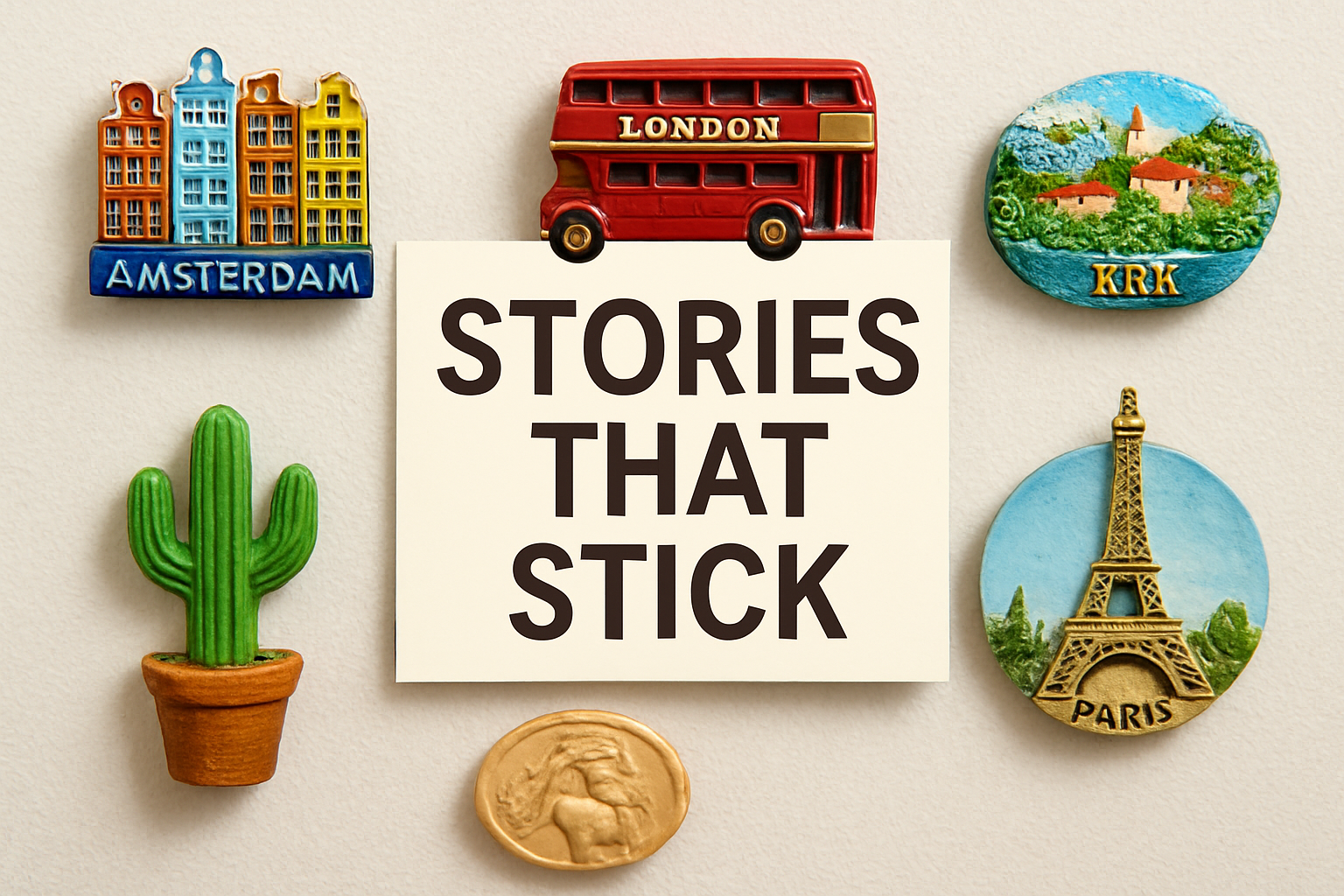
Some stories don’t live in books or albums.
They don’t announce themselves loudly.
They stay quietly, held in place by something small-often no bigger than a palm.
These are the stories that stick.
They live on fridge doors as everyday galleries, tucked between grocery lists and postcards, attached by magnets we barely notice anymore. Yet every time we walk past, they’re there-waiting. Not demanding attention, just offering memory.
When Objects Start Telling Stories
A magnet is easy to overlook. It’s practical. It’s ordinary. It holds things in place.
But over time, something shifts.
A magnet picked up in a foreign city stops being just a shape and becomes part of travel magnet stories from distant places. It starts carrying the sound of a street, the smell of food, the feeling of being somewhere unfamiliar and alive. A magnet gifted by a friend becomes a reminder of connection, not location. Another one marks a turning point-a first solo trip, a move, a goodbye-becoming one of those meaningful travel souvenirs that stays long after the moment passes.
The object stays the same.
The story grows.
Why These Stories Stay With Us
Unlike photos stored in phones or posts buried in feeds, fridge magnets are unavoidable. You see them when you’re half-awake, when you’re tired, when you’re not trying to remember anything at all.
That’s their power.
They don’t ask for space in your mind. They simply exist in your life. Over time, repetition turns presence into familiarity, and familiarity into meaning.
Stories that stick don’t rely on grand moments. They rely on return.
The Quiet Narrative of Everyday Life
A fridge door is opened dozens of times a day. And each time, it carries a quiet narrative.
A magnet holding a recipe from last winter-one of those functional fridge magnets that quietly blends memory with everyday use.
Another one keeping a boarding pass you never threw away.
A third one slightly crooked, refusing to stay straight no matter how many times you fix it.
Together, they tell a story that isn’t linear. It doesn’t have a beginning or an end. It’s layered, interrupted, unfinished-just like life.
This is storytelling without structure. And somehow, it feels more honest.
Stories Without Words
Not all stories need language.
A magnet shaped like a house might represent safety.
A subway token might represent movement.
A simple square magnet might mean nothing to anyone else-but everything to you.
These objects communicate through association. Through memory. Through feeling.
They don’t explain themselves. They don’t need to.
When Stories Are Shared
Sometimes, someone asks.
“Where is that from?”
“Why do you have this one?”
And suddenly, a story surfaces, revealing how some magnets become magnets that are more than decoration. A moment you hadn’t thought about in years finds its way back into conversation. Not because you planned to tell it-but because something physical invited it out.
Stories that stick don’t just live with us. They move between people. They connect past and present, one question at a time.
The Difference Between Collecting and Keeping
Not everything we collect becomes a story that sticks.
Some magnets are impulse buys. Some are placeholders. Some lose meaning over time. And that’s okay.
The difference lies in keeping.
The magnets that stay aren’t always the prettiest. They’re the ones that feel necessary. The ones you never quite consider removing. The ones that still say something, even years later.
Stories that stick choose us as much as we choose them.
Letting Stories Change
A story doesn’t have to remain the same to remain meaningful.
A magnet that once represented excitement might later represent nostalgia. One that marked a beginning might eventually mark distance. Meaning evolves, and the object adapts.
Sometimes, organizing a growing magnet collection isn’t about tidying up, but about acknowledging that the story itself has shifted.
And sometimes, it’s okay to let one go-knowing the story lives on, even without the object.
Why Small Stories Matter
Big stories get told often. Small ones don’t.
But small stories are the ones that shape us daily. They’re the reminders of quiet courage, fleeting joy, ordinary happiness. They’re proof that not every meaningful moment announces itself as such.
Stories that stick don’t shout.
They stay.
Final Thoughts
A fridge covered in magnets might look chaotic to someone else, but to you it’s about turning your fridge into a personal gallery.
Stories that stick aren’t about travel alone. They’re about presence. About noticing what we carry with us—and why.
Because sometimes, the stories that shape us most are the ones we pass every day without realizing they’re still speaking.
And sometimes, all it takes for a story to survive is something small enough to stick.

Leave a Reply